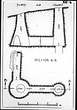
Cistern at 75/ΜΓ connected with cistern N 18:3 by tunnel.
Only coin is Bioiotian dating between 220 and 197. Only indications of date are 1st c. lamps, two long-petal bowls, and fragments of early Roman ... 1st. c. B.C.
Well at 72/ΟΔ.
Partially excavated to depth of 8m. Turkish fill in upper 3m. Hellenistic fill mostly of roof tiles and coarse pottery. Coin
12 February 1937 #4 (disintegrated) ... 3rd c. B.C.
Well at 73/ΜΓ.
The upper walls were of small stones but changed to tiles at a depth of ca. 12m which suggests that it perhaps was originally built in Late Roman times ... Byzantine
Well at 73/Μ on the lower northeast slope of the Areopagus.
Diameter of 0.90m. It seems to have been abandoned because of the very soft stereo that kept falling in from all sides. Many pieces of terracotta ... Ca. 430-420 B.C.
Cistern at 77/Μ on lower north slopes of the Areopagus. Bottom diameter of 2m connected by tunnel to cistern M-N 18:1.
Only stamped amphora handle dates slightly after 240. Latest coin dates about 200 ... 3rd c. B.C.-196/190 B.C.
Well at 69/ΟΒ (Late 5th c.)
Lower fill dated to 420-400 B.C. in Agora XXX.
There were no use filling and the well was apparently not a success as a water-supply: there was no concentration of water-jars ... 420-400 B.C.
Section Χ 1937 ... Margaret Crosby ... The area signified as Section Χ lays outside the Agora proper and no signs of any public buildings were found. The area seems to have been used for private houses from the end of the 6th c. B.C. Apart ... 25 Jan-18 May 1937