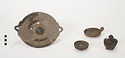
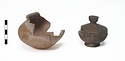
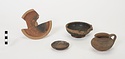
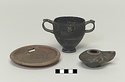
[Agora Deposit] I 14:2: Pithos Settling Basin

Located in front of west end of Stepped Retaining Wall, Heliaia. Filled in and covered in last stages of grading of area after construction of Middle Stoa. Pottery from settling basin nondescript. Single ... 175-150 B.C.

icon

[Agora Deposit] A 18:9: Sacrificial Pyre over Drain A1

Grave over drain A1 (House A). Date based on the fact that the lopas has the upturned handle and the flat rather than domed lid, not found in examples from the later pyres. LT West of House C. Pottery ... First half of 4th. c. B.c.

icon

[Agora Deposit] Q 17:5: Disturbed Pyre

Disturbed pyre containing only a pyxis and a chytridion. No notebook account of excavation exists. The pyre may have been located at the edge of an ancient road. There is no record of bone or burning ... 350-325 B.C. (?)

[Agora Deposit] R 17:6: Flask-Shaped Cistern

Flask-shaped cistern (1959) (Cistern under Room 4 in NE corner of Section). Upper filling soft silt with a little pottery. Lower filling hard silt, almost no pottery. 1.35m in diameter at the floor with ... End of the 4th c. B.C.

[Agora Deposit] A 8-9:1: Hephaisteion Garden Fill

Hephaisteion Garden; fill beside wall. Loose filling encountered in rescue excavation to examine wall found during construction of public toilet in Theseion Park, outside Agora area. SIR 1991 Originally ... Second half of 4th c. B.C.

icon

[Agora Deposit] R 11:5: Pyre in Stoa Shop VI

Shallow pit below layer I in Stoa Shop VI (Pyre) Diameter 0.90; D. 0.15m Under shop VI of the Stoa of Attalos Pottery, ash, burning and packing of small stones in pit in stratum. The pyre was covered by ... Ca. 350 or 325 B.C. ?

icon

[Agora Deposit] R 18:1: Pyre

Small pit (in Layer I) = Grave ("Pyre") Identified as pyre by SIR. Pottery and burning ("pit filled with black") in pit slightly west of Panathenaic Road, dug into layer I (lot AA 180, much earlier 6th ... 275-250 B.C.

icon

[Agora Deposit] F 13:1: Disturbed Sacrificial Pyre

"Perhaps a cremation burial ... " nbp. 811. "Sacrificial pyre, disturbed," GRE, deposit nb. In room on east side of building. Concentration of artifacts, fragments of bone, and abundant cinders in stratum, ... Early 3rd c. B.C.-Ca. 250 B.C.

[Agora Deposit] G 17:2: Pit

No independently datable objects. Coins: 17 February 1932 #29 18 February 1932 #4 ... 325-300 B.C.

icon

[Agora Deposit] D 16:6: Pyre in Cut in E-W Street

Pyre in cut in E-W street, layer 7 (Pyre 14). North edge of Piraeus street, west of the Great Drain Bridge, in the area west of Areopagus. RSY-Pyre. Pottery, a little burnt bone, and patches of charcoal ... 250-240 B.C.

[Agora Deposit] T 26:7: Filling in Overflow Channel

Klepsydra: Filling in overflow channel = Channel A, North of Paved Bldg. (was T 26-27:1) Three layers, all containing a mixture of early material (LHIIIC and Protogeometric) with late Hellenistic and early ... Mid 1st. c. A.D. with later intrusions

[Agora Deposit] B 19:8: Pit in House N Room 4

House N, Room 4, Pit through layers 5-6. Debris filling, mixed context. Estimated Grid ... Late 4th. c. B.C. into early 3rd c. B.C.

icon

[Agora Deposit] H 17:1: Child's urn burial

Grave 4 in notebook: urn burial. Lower part of a storage jar (P 15407) containing the bones of a small child along with a black glazed kantharos (P 15409) and a banded pelike (P 15408) ... 325-300 B.C.

[Agora Deposit] H 17:6: Pocket in Bedrock

Pocket in bedrock, 50/Λ (= Trench, 50-54/Λ), measuring 4.00x0.60m, 0.60-0.90m deep; possibly cutting for wall foundation Coins: 22 April 1932 #1 ... 330-300 B.C.

icon

[Agora Deposit] B 18:2: Pyre in House C, Room 12

Pyre in House C, Room 12 (RSY=Pyre 9) in the industrial area west of the Areopagus. Notebook refers to House N. Beside west wall of room 12. Pottery, burnt bone, and cinders in a roughly round pit; disturbed ... Ca. 250 B.C.

icon

[Agora Deposit] O 17:6: Phaidon Street Cistern: South Chamber

Phaidon Street Cistern: South Chamber. Connected by tunnel to O 17:5. Knidian stamped amphora handle; fragments of five long-petal bowls, one made in worn mold. Type 35 A lamp. Coins 9 August 1957 #1-#3 ... Late 2nd c. B.C.

[Agora Deposit] D 15:4: Pit

Lower filling mostly of second half of 4th c. B. C. and earlier, but perhaps dumped in 3rd c. B.C. Upper filling mixed to Roman (4th c. A.D.). Pottery in container (9-22-58) is mostly second half of 4th ... Ca. 375-325 B.C. with late-3rd-century disturbance

[Agora Deposit] F 6:3: West Chamber

The West Chamber of a double cistern lying between the northeast corner of the Theseion and the Annex to the Stoa of Zeus Eleftherios. ... Both chambers went out of use as water containers simultaneously ... 225-165 B.C.

[Agora Deposit] D 16:8: Pit 2

Pit 2 in Grave area. Small deposit in a pit; a fragment of a red-figured nuptial lebes recalls the early Kerch style of the second quarter of the 4th c.; the deposit as a whole runs somewhat later ... Ca. 375-315 B.C.

[Agora Deposit] D 11:8: Cistern C

Cistern C (pit) in West Room of late Roman House. Mixed dump of material, with a little Classical, much Roman dating at least as late as 3rd century A.D., and large amount of late Hellenistic. Coins: 1 ... Late Hellenistic and Roman

[Agora Deposit] C 20:3: Cistern

Cistern with mixed dumped filling uniform throughout cistern and two short blind channels. Coins: 16 May 1939 #6-#7 17 May 1939 #1 ... 6th-1st c. B.C.

[Agora Deposit] E 29:2: Drawshaft, Cistern in Court K, House of Greek Mosaic

Cistern System in East Portico. Drawshaft with two blind tunnels, in court of House of the Greek Moisaic; partially excavated by Dorpfeld. No legible coins or amphora handles. Coins: 26 June 1964 # ΔΕ3 ... 2nd c. B.C.

[Agora Deposit] K 6:2: Filling West of Peribolos of the Twelve Gods

4th century sandy fill west of Peribolos of the Twelve Gods, with animal bones, metal waste and much pottery. Estimated Grid ... 350-325 B.C.

icon

[Agora Deposit] G 13:3: Pyre

In room A. Concentration of artifacts and burning in stratum, no pit discerned. The pyre lay below a Late Hellenistic fill with a smooth earth surface. It is described as a black patch of earth with sherds, ... 350-250 B.C.

[Agora Deposit] F 12:7: Cistern Passage/Drawshaft

Part of cistern system with mouths at 47/ΛΒ, 60/ΜΖ and 51/ΜΓ. Last 1.50m. of 47/ΛΒ probably cut in modern times, contained modern fill in bottom. Coins: 10 March 1934 #2-#7 12 March 1934 #9-#14 16 March ... Hellenistic and modern.

[Agora Deposit] C 8:5: Well

Cistern System #1e: Shaft at 11/ΞΑ. Agora XXIX: "Well (not cistern shaft, as in Agora XII) ... Communicates with water system through small hole (see C 8:1) probably fortuitously. Single fill, mostly of ... 350-300 B.C.

[Agora Deposit] Q 17:9: Manhole South of Well G

Manhole-square pit providing access to aqueduct; the dumped filling includes many fragments of coarse pottery, including 5 stamped amphora handles ... Late 2nd-1st c. B.C.

[Agora Deposit] B 12:2: Drawshaft

Cistern system on Kolonos Agoraios; shaft leading to chamber (76/ΝΘ) Coins: 4 June 1936 #1-#4 ... 3rd. c.

[Agora Deposit] M 18:5: Drain Trench at 62/ΜΗ

Drain Trench at 62/ΜΗ. The presence of a number of fairly well preserved vases of good quality suggested to the excavator the possibility that the cutting might once have contained a burial. No skeletal ... 325-300 B.C.

icon

[Agora Deposit] P 6:5: Pyre

Pyre in layer "9d" in SW corner of Room 6 of Greek House δ. Ashes and fragments of small bones ... Ca. 225 B.C.

icon

[Agora Deposit] J 3:2: Sacrificial Pyre II

Sacrificial Pyre II, Classical Building II. Found right beneath the stuccoed channel built for sluicing in the 1st c. A.D., and must have been partly disturbed when the channel was constructed. It may ... Ca. 250 B.C.

[Agora Deposit] P 10:3: Tiled Well in Square Building Foundations

Tiled Well in Square Building Foundations, equipped with evenly spaced hand-holds, with a good supply of water. There was no period of use represented and the dumped fill consisted mostly of chunks of ... Third quarter of 4th c. B.C.

[Agora Deposit] G 12:6: Rubbish Pit

Indicated as "Grave 6" in notebook but recognized as not a grave: "probably a rubbish pit" [deposit notebook summary]. Concentration of pottery, burning, animal bones, snail shells and seashells, probably ... Late 4th-early 3rd c B.C.

[Agora Deposit] G 12:20: Pits in Floor of Tholos

From disturbances in original floor of Tholos with ash and burning. Probably reflects the military and political conditions of 307 B.C. The broken pottery, both that left lying on the floor of the building ... Ca. 340-295 B.C.

[Agora Deposit] E 29:4: House of Greek Mosaic

Stroses I, II, III, IV in Court J (below marble chip layer), House of Greek Mosaic. No independently datable objects. Estimated Grid ... Early 3rd c. B.C.

icon

[Agora Deposit] B 19:1: Rubbish Pit/Pyre

Rubbish Pit . Pit cut through a house floor. In courtyard, beside door to room 3. Artifacts, bone and scattering of large cinders in roughly rectangular pit dug through floor bedding and covered by red, ... 325-300 B.C.

[Agora Deposit] C 14:7: Pit

Small deposit in bedrock. Coins: 20 April 1936 #2-#3 ... 4th c. B.C. to early 3rd c. B.C.

[Agora Deposit] H 14:2: Drain North of Southwest Fountain House

Silt fill of early road drain to North of SW Fountain House. Coins: 10 August 1961 #5 ... 325-275 B.C.

icon

[Agora Deposit] B 18:4: Pyre

Pyre in House T, Room 1, Layer 5-6 (RSY=Pyre 3) in the industrial area west of the Areopagus. First quarter 4th. c. B.C. Artifacts, bone, and cinders in pit in floor sequence. The pyre was found in digging ... 400-375 B.C.(?)

icon

[Agora Deposit] B 22:3: Burned Deposit

Burned deposit: Middle Terrace, south of Archaic cemetery. RSY: Pyre 10. Pottery, burnt bone, charred logs, and heavy burning, recovered by tunneling under the cement floor of a Late Hellenistic workshop, ... Ca. 325-300 B.C.