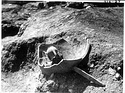
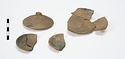
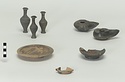
Q 18:4: Stone-Curbed Well at 18/ΞΓ

Stone-curbed well at NE corner of 18/ΞΓ ... 2nd c., at least as late as ca. 140 B.C.

B 22:2: Grave of a dog

RSY Fido's Grave ... Hellenistic

I 14:2: Pithos Settling Basin

Located in front of west end of Stepped Retaining Wall, Heliaia. Filled in and covered in last stages of grading of area after construction of Middle Stoa. Pottery from settling basin nondescript. Single ... 175-150 B.C.

G 15:4: Pit

Coins: 20 February 1932 #1-#2 ... 4th c., with Roman intrusion

F 30:1: Martyr

Martyr at Δ6. Top strosis (Byzantine-Turkish) discarded. Strosis 2, late Hellenistic (Lot ΔΕ 21) Strosis 3, early Hellenistic (Lot ΔΕ 22) Strosis 4, to mid-4th c. B.C. (Lot ΔΕ 23) Nothing catalogued from ... To mid-4th c. B.C.

F 16:7: Child's Burial- Pyre

Child's burial in south wall of Marble Worker's House. Bones examined 20 June 1975 and found to be an immature animal, not human (canid-puppy?). Identified as pyre by SIR. Set into a shallow roughly ovoid ... Late 4th c.

B 19:8: Pit in House N Room 4

House N, Room 4, Pit through layers 5-6. Debris filling, mixed context. Estimated Grid ... Late 4th. c. B.C. into early 3rd c. B.C.

Q 16:1: Cistern A

Cistern chamber in the area of the southeast Temple, the mouth cut back in antiquity ... Late 4th - early 3rd c. B.C.

icon

E 29:3: Possible pyre

Above bedrock in N.W. corner of room S, House of Greek Mosaic. Contents suggest "saucer-pyre" ... Late 4th-early 3rd c. B.C.

icon

H 17:1: Child's urn burial

Grave 4 in notebook: urn burial. Lower part of a storage jar (P 15407) containing the bones of a small child along with a black glazed kantharos (P 15409) and a banded pelike (P 15408) ... 325-300 B.C.

E 29:2: Drawshaft, Cistern in Court K, House of Greek Mosaic

Cistern System in East Portico. Drawshaft with two blind tunnels, in court of House of the Greek Moisaic; partially excavated by Dorpfeld. No legible coins or amphora handles. Coins: 26 June 1964 # ΔΕ3 ... 2nd c. B.C.

L-M 19:1: Channel

Channel to West of Cistern at 63/ΞΒ. Part of Cistern System A which includes the cistern 63/ΞΒ (M 19:2), this channel to the west, and the manhole at 57-58/ΞΔ-ΞΕ. Coins: 31 May 1946 #1 3 June 1946 #1 6 ... Early 3rd c. B.C.

I 16:5: Cistern

Cistern at 79/Γ (= 80/Δ) on lower north slope of the Areopagus. Filling of 2nd c. B.C. with some later intrusions (Turkish pottery indicates disturbance). Single Knidian stamped amphora handle dates around ... Hellenistic-Turkish

M 18:5: Drain Trench at 62/ΜΗ

Drain Trench at 62/ΜΗ. The presence of a number of fairly well preserved vases of good quality suggested to the excavator the possibility that the cutting might once have contained a burial. No skeletal ... 325-300 B.C.

P 10:3: Tiled Well in Square Building Foundations

Tiled Well in Square Building Foundations, equipped with evenly spaced hand-holds, with a good supply of water. There was no period of use represented and the dumped fill consisted mostly of chunks of ... Third quarter of 4th c. B.C.

Q 9-10:1: Cistern System: Stoa Terrace at Piers 11-12

Cistern System: Stoa Terrace at Piers 11-12. Probably abandoned at the time of the construction of the Square Peristyle ... 350-325 B.C (?)

G 12:6: Rubbish Pit

Indicated as "Grave 6" in notebook but recognized as not a grave: "probably a rubbish pit" [deposit notebook summary]. Concentration of pottery, burning, animal bones, snail shells and seashells, probably ... Late 4th-early 3rd c B.C.

R 19:1: Well at 9/ΙΣΤ-ΙΖ

Well at 9/ΙΣΤ-ΙΖ has been cleaned and stripped of its tiles and original filling and bedrock thrown back into shaft. Joins between sherds from all levels. No coins or lamps. Containers examined 5 March ... 1st c. B.C.

H 14:2: Drain North of Southwest Fountain House

Silt fill of early road drain to North of SW Fountain House. Coins: 10 August 1961 #5 ... 325-275 B.C.

icon

P 6:6: Pyre

Pyre in layer 2a in Room 9 SE of Greek House δ. Sand, gravel, ashes, iron nails, carbon, some bones partially cut away by foundation trench of SYPE wall. Coin 1 July 1971 #459 ... 260-200 B.C.

T 17:3: Channel J

Channel J (in ΗΗ) Cutting that probably originally held a drain. Packed with amphoras and other coarse pottery. It tapped the poros aqueduct wall just East of our explanatory trench at the East end of ... 1st c. B.C. - early 1st. A.D.

H 14:3: Strosis

Gravel above cobbled street surface ... Second half 2nd c. B.C.

E 14:9: Pit

Large pit in the bedrock over Wells H and I. Fill of the pit thrown in after filling of Well H, containing almost entirely coarse ware. First 4m of Well I, filling the same. Below that Well I fill similar ... Late Roman- 1st c. A.D. (mainly early ?)

H 13:1: Well in Road West of Middle Stoa

Located in road west of Middle Stoa. It was 4.80m deep. Owing to its shallowness, it was probably kept clean. The southernmost block of the N-S peribolos (?) wall west of the Middle Stoa partly covered ... 200-165 B.C.

I 17:5: Drawshaft, Cistern Shaft at 63/ΚΓ

Cistern shaft at 63/ΚΓ. Part of H-I 16-17 system. Contents of 3rd c. disturbed. Part of extensive cistern system, of which one chamber, three drawshafts, and two blind tunnels were excavated (H 16:2, ... 3rd c., disturbed

Q 9:4: Foundation of South Stylobate of Square Building

Trench for foundation of south stylobate of Square Building (between Piers 12-13) ... Late 3rd-early 2nd c. B.C.

G 14:5: Cistern: Southern chamber

Connected with G 14:3. There was a layer of Late Roman fill. It rested over a layer of 2nd c. B.C Hellenistic and then another of 4th c. B.C Hellenistic; the passage between the two cisterns contained ... Late Hellenistic

C 18:3: Roman Bath - "Compartment"

Deposit in the industrial area west of the Areopagus, underlying a Roman bath. Pottery examined in June 1955; latest pieces noted: one fragment Pergamene and one fragment brittle ware; no certainly post-Sullan ... Late 2nd c. B.C.

B 21:25: Cistern in ΝΝ

Pit (= collapsed cistern). Fill mixed, late Hellenistic to early Roman. The cistern floor has an E-W channel, no doubt running from the pit at 107/Ζ to the well at 107/ΙΓ (B 21:24). Coins: 10 June 1939 ... 150-100 B.C.

E 29:1: Cistern North of House of Greek Mosaic in ΔΕ

Lower levels of cistern to N. of House of Greek Mosaic. Connected by tunnel to another chamber that was apparently cleared by Wilhelm Dorpefeld in the 19th c. Roman fill in mouth. Coins: 6 July 1964 # ... Ca. 325-290 B.C.

D 17:11: Well

Upper fill early Roman. Lower fill latest Hellenistic. No house walls clearly associated with it, and apparently no attempt made to assign it to any particular house. Subdivisions: .1=Upper fill .2=Lower ... Late Hellenistic-Early Roman

B 14:6: Cistern in ΠΘ

Coins: 9 April 1937 #3-#4 10 April 1937 #3-#4 12 April 1937 #2 13 April 1937 #1-#3 ... Ca. 300-140

G 11:1: Cistern Chamber III

Cistern system West of Bouleuterion: (see also B: cistern system to West of Tholos). Third Chamber from North. A well was dug through the bottom in Byz. times. Cf. deposit F 9:2. Coins: 3 May 1934 #1 ... 160-140 B.C., with Byz. disturbance Early 3rd to late 2nd c. B.C. POU

B 13:3: Drawshaft

Cistern system on Kolonos Agoraios, shaft into south passage (81/ΝΘ). The fill again seemed to be a dumped fill; probably rather late 3rd. c. Coins: 8 June 1936 #1-#3 ... Late 3rd. c.

E 15:2: Drawshaft, Part of Cistern System at 94/Θ

Part of cistern system at 94/Θ. Coins: 12 March 1934 #7-#9 14 March 1934 #38-#41 ... 275-200 B.C.

Q 11:3: Ash and Carbon Dump

Ash and Carbon Dump in Corridor directly behind Room C of Brick Building. This material comprises what appears to have been a household dump associated with the period of use of the Brick Building, but ... To mid-2nd century

B 15:4: Well

Diameter 0.95m; water level -9.10m. Plais shaft cut in stereo from bottom of slender flask-shaped cistern. Scanty fill from house destruction in 5th c. A.D.; Christian lamps; unfinished statuette of Castor ... Late Roman

B 18:12: Well

Diameter 0.83m. Water level -4.20m. Tiled well; height of tiles 0.60m. Heavy deposit of pottery throughout; stamped amphora handles, five Knidian; one Rhodian; one Parian. Semi-coarse stamnos; funnel-mouthed ... Ca. 120 B.C.

M 18:2: Fill

Hellenistic Fill at 70/ΛΣΤ. Fill in irregular hollow. Pottery resembles Sullan debris, but lack of late duoviri handles suggests deposit slightly predates the sack. Coins 6 March 1937 #1-#4 ... Late 2nd c. B.C.

D 10:3: Channel Mouth 3

Water channel in north part of section. Coins: 20 February 1936 #2-#3 Five stamped amphora handles; Type 48 A lamp; one-third of bowls long-petal; one long-petal mold ... Second half of 3rd c.-Early third quarter of 2nd c.

R 9:5: Northern Manhole to Water Channel

Northern Manhole to Water Channel [R 9-10], East of Shop 14 ... 2nd c. B.C.

icon

M-N 18:1: Cistern at 75/ΜΓ

Cistern at 75/ΜΓ connected with cistern N 18:3 by tunnel. Only coin is Bioiotian dating between 220 and 197. Only indications of date are 1st c. lamps, two long-petal bowls, and fragments of early Roman ... 1st. c. B.C.

icon

A 16:4: Cistern in ΠΠ

Listed in notebook as at 6/ΛΗ but later found to be at 12/ΛΗ. Originally B 16:1. Large cistern distinguished by a short (1.75m) blind tunnel running SW from its floor, and a shallow (ca. 0.80m originally) ... Ca. 150 B.C.

Q 12:1: Well by Stoa Pier 3.

Well by Stoa Pier 3. Mouth was discovered in 1950 (p. 2273). Between first and second POU; no joins between the groups, which were separated by nearly sterile fill. No apparent chronological difference ... Mid-2nd c. B.C.

S 19:8: Well at 19/Λ

Well at 19/Λ. The bottom of this well contained a considerable quantity of dug bedrock which had fallen in before the well came into use; over this was a fill with oinochoae representing the POU. The presence ... 340-325 B.C.

M 20:4: Well

Well at 72/ΟΔ. Partially excavated to depth of 8m. Turkish fill in upper 3m. Hellenistic fill mostly of roof tiles and coarse pottery. Coin 12 February 1937 #4 (disintegrated) ... 3rd c. B.C.

icon

C 17:2: Pyre North of House G

North of House G (RSY=Pyre 13). Concentration of artifacts, small pieces of bone, and burnt material in stratum, no pit discerned. The pyre is cut by the trench of a wall of a Roman house to north. It ... 290-250 B.C.

icon

B 19:6: Pyre in House N, Room 4

Pyre in House N, room 4 (RSY=Pyre 7), in the industrial area west of the Areopagus. Pottery, mall pieces of calcined bone, log, wood cinders, and charcoal in diamond-shaped pit in floor sequence. The pyre ... Late 4th-early 3rd c. B.C.

icon

E 18:7: Well

Large tile-lined well in SW Bath, Room A4. The top had been sealed with ca. 1.30m of concrete, and the floor to carry the hypocaust columns of the room in Phase C had been carried over it. The well was ... Late 2nd-early 1st c. B.C.

S 19:2: Cistern at 6/ΛΓ

Cistern at 6/ΛΓ. Hellenistic lower fill, with mixed Hellenistic and late Roman fill above, and Byzantine fill in mouth. Coins 1 June 1938 #1-#8 2 June 1938 #1-#6 3 June 1938 #1-#3 4 June 1938 #1-#2 6 June ... 2nd century, with Byzantine disturbance

D 19:2: Well

Well on the lower west slope of the Areopagus. Tiled well. The tiles were carefully made and clamped together with lead, two clamps at each joint. Several fills but apparently all 2nd c. Material in lowest ... Late 2nd to early 1st c. B.C.

C 10:1: Manhole, Channel Mouth 1

Water channel in north part of section, giving access to water system. Channel Mouth 1. Six stamped amphora handles; two-thirds of bowls long-petal ... Late 2nd century-Early 1st c. B.C.

Q-R 10-11:3: Destruction Layer

Destruction Layer, Brick Building. It represents material from the layer of fallen brick covering the floor and wall socles of the Brick Building and therefore marking the destruction of the structure ... To ca. 165

B 18:7: Well

Fillings in a stone-curbed well in the industrial area west of the Areopagus. Diameter (shaft)1.45m. Water level -5.20m. Drain at mouth 0.58m., increasing to a regular 74m. Coin: 24 July 1947 #5 Subdivisions: ... 350-325 B.C./3rd c. B.C.

icon

A 17:3: Pit

Pit, partly cleared; dumped filling of first half of 3rd. c. B.C., but with considerable material of the 4th. c. Hellenistic. Its rotten schist walls collapsed some time near then and it was filled up ... 4th-3rd c. B.C.

B 21:24: Well

Well. Construction, use and dumped fillings of the Hellenistic period. Tile-lined well with a packing of jars behind the tiles; the well cut through (Fill 4) the passage of a cistern (B 21:25). At 9.00m ... Hellenistic

icon

L 17:7: Aischines Street Cistern: South Chamber

Date of filling early third c. B.C. Little pottery. Seven stamped amphora handles. Latest coin dates in first third of 3rd c. One small fragment of moldmade bowl of undetermined type. Coins: 12 August ... 310-220 B.C.

B 18:13: Cistern in Room 12

Cistern in Room 12, House C=House N. Simple flask-shaped chamber with draw shaft, in House M, Room 1; no tunnels. Excavated as single fill, but later analysis of material suggested two fills. Coins: 24 ... 4th. c. B.C.

J 2:1: Well West of N-S Street

Well West of N-S Street. Coin 2 August 1982 #704 ... Ca. 115-75

F 16:6: Rectangular Shaft

Rectangular shaft at northwest foot of Areopagus; dumped filling of second half of 4th c. B.C. Pit at 16/Δ-Ε recorded one time as an extension of shaft 17/Δ-Ε (see L 506 and nb.p. 395), but items from ... Ca. 325-275 B.C.

P 10:2: Cistern

With cistern at 18/Π (P 10:1), two chambers connected by a passage. 18/Π went out of use first and was closed off from 17/ΟΕ-ΟΣΤ; filled up at one time with material dating between 350 and 300 B.C. 17/ΟΕ-ΟΣΤ ... 17 April 1937 27-28 May 1937

icon

H 16:1: Well

Well on lower northwest slope of Areopagus. Dug to 6.60m. and abandoned because of danger. Single dumped deposit. Perhaps this context: P 528, P 1223 (JWH). Coins: 22 April 1932 #1 ... Second half 1st c. B.C.-early 1st c. A.D.

G 11:4: Well to West of Tholos.

See cistern system wells F 11:2 and F 12:3, part of Tholos water system. Estimated Grid ... Ca. 350-294 B.C.

K 7:1: Hellenistic Fill

Hellenistic fill, north of Temple of Ares, on either side of wall running east-west over 50/ΙΓ. Mostly coarse pottery including many stamped amphora handles. Cf. also nb. P XII, pp. 2297-2298. Coins: 13 ... 275-200 B.C.

O 20:1: Cistern at 63/ΛΑ

Cistern at 63/ΛΑ (part of cistern system 63/ΛΑ-65/ΜΑ-70/ΛΣΤ, consisting of two chambers and a well). Roman upper fill with modern cesspool fill above. Channel finds: MC 517, SS 8078. Only datable object ... 300-195 B.C.

icon

F 19:6: Well

Unfinished well-shaft with debris filling (apparently of the Sullan sack), on the lower NW slopes off the Areopagus. Abandoned due to poor quality of bedrock. Three closely contemporary fills, considered ... End 2nd c. B.C.-second quarter 1st c. B.C.

icon

O 16:3: Tiled Well at South Edge of EW Road

Tiled Well at S edge of E-W Road, 73/ΜΗ. Contemporary upper and lower fills separated by layer of sterile mud. Latest coin dates ca. 200. Koan amphora handle with stamped handle dates slightly after 200 ... 210-160

icon

O 17:5: Phaidon Street Cistern: North Chamber

Phaidon Street Cistern: North Chamber Sullan destruction debris. One of two chambers connected by tunnel. Two latest coins date to 87/86. Gray ware lamp of first quarter of 1st c. A.D. indicates disturbance ... 2nd c. B.C.

E 10:1: Manhole, Channel Mouth 4

Water channel in north part of Section: Channel Mouth 4. Coins: 22 February 1936 #16-#18 24 February 1936 #1-#2 Twenty stamped amphora handles; type 38 lamp; type 56 A lamp; over half of bowls long-petal ... 120-86 B.C.

icon

N 10:2: Filling in Footing Trench

Filling in footing trench at 63/ΝΔ Packing of coarse pottery, including numerous stamped jars and a small amount of kitchen ware ... Ca. 250-210

R 13:9: Cistern

Bottle-shaped cistern at R/1-13/14,15, probably associated with the building which lies under the Northwest Stoa. Single dumped fill. Coins 11 June 1975 #822 11 July 1975 #864 July 1997 samples taken by ... 300-265 B.C.

E 15:4: Drawshaft

Cistern shaft southeast foot of Kolonos Agoraios. Unstratified fill. Ten stamped amphora handles; Type 34A lamp; many fragments of long-petal b suggesting material deposited ca. 140 or later. Cf. Pireus ... Ca. 200-125 B.C.

P 10:1: Cistern

With cistern at 17/ΟΕ-ΟΣΤ (P 10:2), two chambers connected by a passage. 18/Π went out of use first and was closed off from 17/ΟΕ-ΟΣΤ; filled up at one time with material dating between 350 and 300 B.C ... 325-285 B.C.

B 20:2: Drawshaft

Filling in a cistern chamber in the area west of the Areopagus. Main dumped fill of 2nd. c. B.C., with small amount of later material in uppermost 1.00m. A connecting passage contained some material of ... 2nd. c. B.C.

B 13:1: Chamber Cistern

Part of cistern system 76/ΝΖ-76/ΝΘ-81/ΝΘ on Kolonos Agoraios with lower dumped filling of 3rd. c. B.C. and upper dumped filling of first half of 1st. c. A.D. Coins: 4 June 1936 #5 5 June 1936 #3 6 June ... 3rd. c. B.C.-1st. c. A.D.

R 13:2: Well

Well in street leading to Roman Agora. Not excavated below 2.10m. This has the same date as the latest pieces in R 13:1 (JWH). Coins: 6 August 1946 #1-#3 Estimated Grid ... Ca. 40-50 A.D.

M 23:1: Cistern in NW Corner of Byzantine Building

Chamber of water system with one blind tunnel and two cisterns connected by tunnel. Pottery consistent throughout, late Hellenistic. Late 2nd c. B.C. Ten stamped amphora handles. Most of bowls long-petal ... 100-75 B.C.

Q-R 10-11:1: Construction Fill Below Floor of Brick Building

Construction fill below floor of Brick Building. Areas involved: a) Western portion of Room A: packing below floor. b) Room B: packing below floor of northern,larger room. c) Fill over water channel in ... First quarter 2nd century, before its end

E 14:6: Well H

Upper fill was early Roman dated by AWP to the 1st c. A transitional fill was later assigned to the upper level. Nbp. 2913: The history may have been that the well was cleaned out at the time that it was ... 3rd-2nd century B.C and Roman date.

icon

N 19:2: Roman Well at 52/I

Well at 52/Ι, on the lower northeast slopes of the Areopagus. It was cut down and re-used in the late Roman period, in connection with the water channel. Use fill of 1st to early 2nd c. Dump fill 5th to ... Early to Late Roman

D 5:2: Drawshaft

Cistern system, 88/ΝΓ (shaft and passages). Apparently a dumped filling of Roman times, drawn mostly from some Hellenistic deposit. Coins: 31 March 1937 #1-#5 1 April 1937 #4-#5 3 April 1937 #1-#2 5 April ... Hellenistic and Roman, 4th c. A.D.

D 17:3: Cistern at 65/KH

Cistern at 65/ΚΗ (and Channel). Cistern in the northwest room of the annex to the Poros Building west of the Areopagus. Part of the same system as D 17:4 and D 17:5, the chambers connected by long tunnels ... 300-250 B.C.

P 20:2: Cistern at 72/ΛΘ

Cistern at 72/ΛΘ. Under NW corner of Roman House H. Stucco-lined, bottle-shaped cistern, poor condition. Diameter at bottom -2m. Two tunnels, one leading east, one west, ca. 1.65m high and 0.80m across ... 150-110 B.C. with a few earlier pieces

I-O 15:1: Soundings below floor of South Stoa II.

The data in the Deposit Notebook is presented by trench; an attempt is made here to accumulate data from similar layers across the trenches. Subdivisions: .1=Post Hadrianic cleanup .2=Marble working waste ... 2nd c. B.C.-3rd c. A.D.

S 21:1: Well at 35/ΙΘ

A well outside the market square to the southeast, 20m west of the Panathenaic Way; Modern fill in upper 1.65m. with Early Roman dumped fillings below. Coins: 9 May 1939 #37 (dirt pile) 10 May 1939 #53 ... Late 1st c. B.C.-early 1st c. A.D.

E 6:1: East Chamber at 69/Λ

Cistern System #3: East Chamber at 69/Λ, joined by a crooked passage to 69/ΛΣΤ. Under the southwest corner of the Hellenistic Building to the north of the Temple of Hephaistos ... 175-125 B.C.

N 20:6: Cistern at 60/ΙΕ

Cistern at 60/ΙΕ; bell-shaped cistern with a channel 1.65m high and 4.60m long, leading to a dead end against bedrock. This channel runs north with a slight curve to the east and looks as though it was ... Second half of 3rd c. B.C.-Early 2nd c. B.C.

N 20:1: Well

Use filling of first half of 1st c.; dumped filling of late 1st c.(?). This well, near its mouth, cuts off the end of the upper passage of the cistern at 53/Ε. Subdivisions: .1=Dumped filling .2=POU ... First half of 1st c. A.D. POU

D 16:1: Cistern A

Cistern (diameter 0.90m) with two channels; the fill of the cistern proper, below the scant upper (Byzantine) deposit, appears to have been dumped all at the same time, to 325-275 B.C. Notebook says "all ... 325-275 B.C.

D 17:4: Cistern at 70/ΚΕ

Cistern at 70/ΚΕ and channels. Part of same system as D 17:3 and D 17:5. It was set against a corner of the lowest foundation block. Thus one is forced to assume that enough of the wall remained at least ... Ca. 200-150 B.C.

Q 13-14:1: Cistern at 21/ΙΗ

Cistern at 21/ΙΗ Period of use fill dated to ca. 375-350 B.C., Upper fill dated to mostly first half of 6th c. B.C. in Agora XXX ... Ca. 375-350 B.C.

icon

K 18:2: Cistern on Lower North Slope of Areopagus

Cistern on lower north slope of Areopagus. Latest of thirteen amphora handles dated ca.199; twelve legible coins, the latest dating ca. 196-190. Three intrusive pieces:two semiglazed fragments and piece ... 260-190 B.C.

E 14:7: Well C

Two periods of use. Outside the SW corner of the market square, to the west of the north-south road; lower use of filling, of 1st to early 2nd c. A.D. Coins: 26 May 1937 #1 [to 8.30m.] 9 June 1937 #2-#4 ... 10 -11 June 1935 20 May-20 June 1937

O 20:2: Cistern at 70/ΛΣΤ

Cistern at 70/ΛΣΤ in the northeast slope of the Areopagus. Part of system with two chambers and well. Homogeneous fill. 13 stamped amphora handles. Latest lamp type 46 B. N 72206 (Ω-344), picked up near ... Second half of 3rd c. - Early 2nd c. B.C.

H 6:4: Bronze Head Well

A well behind the Stoa of Zeus. Noted as the finding place of the bronze head of Nike, B 30. Two Rhodian stamped amphora handles. Fragments of only two bowls ... 260-210 B.C.

F 19:2: Cistern

Bottle-shaped cistern with dumped fillings on NW slopes of Areopagus; appears not to have been finished in antiquity: the walls and floor show no traces of stucco. Lower filling, ca. 375-340 B.C. Upper ... Ca. 375-275 B.C.

F 19:3: Well

Unfinished well, all one fill; solid bedrock at a depth of -2.47m. It contained masses of broken rooftiles and probably was used as a refuse pit after the sack of Athens by Sulla. Twenty-three stamped ... Early 1st c. B.C.

E 15:7: Well C

A small concentration of pottery in lowest 1.80m., possibly a use fill. Three fills above, with little pottery, ranging from Hellenistic to late Roman in date. Coins: 26 February 1934 #4-#6 27 February ... 325-200 B.C.

F 12:4: Well

Primarily late Roman material but some scrappy early Roman. Coins: 5 March 1934 #1-#4 6 March 1934 #1-#3 7 March 1934 #1-#2 8 March 1934 #1-#4 9 March 1934 #1-#4 10 March 1934 #1 ... Ca. A.D. 350 dumped fill

F 13:2: Well 7

Dump, 4th c. Cut through a cistern which was probably constructed in the 4th c. B.C, near the southwest corner of the market square. Coins: 25 May 1935 #1 (with L 1809) (disintegrated) Subdivisions: .1=Upper ... Second half 1st c.-end 2nd c.