|
|
Disturbed burial set into a cutting in hardpan. No lot ... 2nd half of 5th c. B.C. |
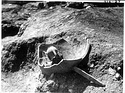
Grave (?) under wall 4. Infant burial(?); a kados, P 16747, lying sideways with a tall cylindrical stand, P 16748, set over it as a cover; the upper parts of the pots cut away ... Late 6th. c. B.C. |
Child's burial in south wall of Marble Worker's House.
Bones examined 20 June 1975 and found to be an immature animal, not human (canid-puppy?).
Identified as pyre by SIR. Set into a shallow roughly ovoid ... Late 4th c. |
Rectangular cutting, not entirely preserved, west of underground drain. Contained good black glazed pottery, some stamped, and a little coarse ware, along with bits of bone and part of a skull ... Third quarter 5th c. B.C. |
| Grave 4 in notebook: urn burial. Lower part of a storage jar (P 15407) containing the bones of a small child along with a black glazed kantharos (P 15409) and a banded pelike (P 15408) ... 325-300 B.C. |
Pit at 57/ΚΑ; small pit on the lower north slope of the Areopagus, measuring 1.05x0.80mx0.80m deep. There were traces of burning and a few bones in it, since none of them are recognizably human it is probably ... 480 - 470 B.C. |
| Grave 3 in notebook. Outside Archaic cemetery, inhumation burial. Deposit list says black glaze pithos (P 8922) containing the bones of a child and four small vases. The pithos lay on its side with the ... Last quarter of 6th century B.C. |
| David Scahill ... Burial in Geometric well (J 3:8), in Classical Building II, Room I, next to south ashlar wall. "No grave goods!"
ADDENDA: J. Papadopoulos later associated P 34449 and P 34450 to that grave. (Cf. Agora ... Geometric |
|
|