|
|
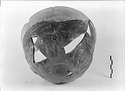
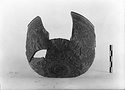
| Mended from three pieces. Scraped grooves round central medallion and just below rim. Imbricated leaf pattern radiating from moulded ring round central wreath(?).Carelessly made; much worn.
Glaze shows ... 17 March 1932 |
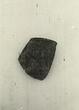
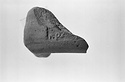
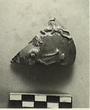
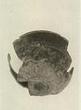
| Wall fragment depicting rampant goat, long-bearded mask and krater.
Firm black glaze.
Cf. Agora XXII, nos. 109-113, p. 109. Cistern. Leica PD 316 ... 1932 |
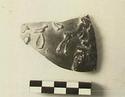
| Wall fragment depicts rampant goats in center. Below are leaves edging the base.
Firm black glaze.
Cf. Agora XXII, nos. 109-113, p. 109. Cistern. Leica PD 316 ... 1932 |
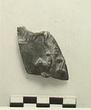
| Wall fragment depicting a lion and a nude male figure hurriedly parting toward the left and right, respectively.
Firm black glaze.
Cf. Agora XXII, nos. 250, 251, p. 109. Cistern. Leica PD 316 ... 1932 |
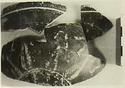
| Wall fragment depicting a cloaked figure playing a double flute.
Firm black glaze.
Cf. Agora XXII, no. 280, p. 109. Cistern. Leica PD 316 ... 1932 |
| About one-third of the bowl remains. Two fragments of the lip, one mended from two pieces, do not join. Restored in plaster. In the medallion, a rosette(?) surrounded by a row of ribbed leaves. From a ... 1932 |
| A fragment of the rim and side wall. The tips of lotus petals spring from the medallion. Pairs of satyrs dancing about kraters compose the frieze. From the feet of the kraters spring tall volutes. The ... 1932 |
| Apparently typical Knidian; junction with neck not preserved.
Coarse red clay, greyish at core.
Mostly of the impression broken away, with large piece of handle; lower left corner preserved.
Group "D" ... Third quarter of 2nd century B.C. |
| Mended from many pieces; a good many holes. Central medallion, face(?) nearly effaced. Surrounded by two grooves, outer one scraped and colored with miltos. Radiating luxuriant wreath. Figured band consists ... 17 March 1932 |
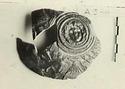
| Rim and most of the side wall missing. The medallion is centered with a 6-petalled rosette, around which are four overlapping rows of ribbed leaves. Goats rampant about kraters in the frieze. In the field ... 1932 |
| Mended from four pieces. The central medallion on the bottom and part of the sides preserved. In the center, outside, within two raised ridges, a Gorgoneion. Beyond the ridges, bands of scale-like leaves ... 1932 |
| Wall fragment depicting nude girl reclining on the knees of a seated youth. In the field to the right are traces of a goat rampant and of an Eros flying above a cluster of grapes.
Glaze on the outside ... 1932 |
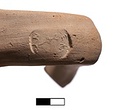
| Knidian type; rather light. Complete handle preserved, with both attachments.
Coarse reddish-buff clay; greyish at core. Remains of light slip. Somewhat micaceous.
Impression incomplete on two opposite ... 17 March 1932 |
| Mended from many pieces. A little more than half preserved with missing fragments. Gorgoneion surrounded by raised band. Double row of small leaves surmounted by four large acanthus leaves (three preserved) ... 1 March 1932 |
| Mended from many fragments: large part of side missing. Central base medallion, frontal face surrounded by plain and dotted ring, scraped groove between, thin double (imbricated) wreath with pin-wheels ... 17 March 1932 |
| Mended from many pieces; about one-third of the rim, the upper part of the front, and smaller pieces from the walls missing and restored in plaster. Moulded ring foot; flaring lip with downturned edge ... 1 June 1932 |
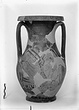
| Identical with P 1104. Much mended; fragments from the walls, the base, and the top of one handle restored in plaster. Here the upper parts of the heads of the horse and the first woman are better preserved, ... 1 June 1932 |
Cistern and drawshaft connected by tunnel; used in modern times as cesspool. No stratigraphy noted, but pottery from first five boxes excavated is later than that from boxes 6-18.
11 stamped amphora handles ... Hellenistic and Late Hellenistic |
Cistern shaft southeast foot of Kolonos Agoraios. Unstratified fill.
Ten stamped amphora handles; Type 34A lamp; many fragments of long-petal b suggesting material deposited ca. 140 or later. Cf. Pireus ... Ca. 200-125 B.C. |
Evidence of stratification into five layers, although joins between the layers. Layer VI added when the construction of the Roman building above required it. No subdivisions assigned.
Flask-shaped cistern ... Early 3rd-late 2nd c. B.C. |
|
|