|
|
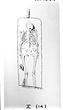
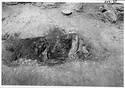
| Grave X in notebook = RSY Grave 14. PD 731-g ... Ca. 525-500 B.C. |
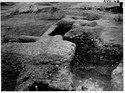
| Sacrificial Pit I in notebook = RSY Grave 20 ... Ca. 510-490 B.C. |
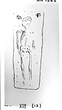
| Grave XIV in notebook = RSY Grave 13. PD 731-f ... Late 6th. c. B.C. |
Fillings in an irregular cutting, the context at one end is of the early 5th. c. and at the other end of the second half of the 5th. c ... Early 5th c. B.C. |
| Sacrificial Pit II in notebook = RSY Grave 7 ... Ca. 540 B.C. |
| Sacrificial Pit III in notebook = RSY Grave 6.
Small bit of calcined bones (discarded?) ... Ca. 550-530 B.C. |
Sacrificial Pit VI in notebook = RSY Grave 18 See also B 21:23 ... Ca. 525-500 B.C. |
| Pyre /Burial (?) disturbed, in the area of the Poros Building west of the Areopagus. In northeast corner of room 4 west.
Concentration of artifacts, tiny slivers of bone, and burning in a layer of fill ... Early 4th c. B.C. |
| Grave XVII in notebook = RSY Grave 15.
Only lower half of skeleton preserved. Bones discarded? ... Last quarter of the 6th. c. B.C. |
| Grave VI in notebook = RSY Grave 10. PD 731-d Ptg. 251 ... Ca. 520-525 B.C. |
Sacrificial Pit V in notebook = RSY Grave 19 ... Last quarter 6th. c. B.C. |
A rubbish pit at the foot of the northwest slope of the Areopagus. Black figured, plain glazed vases and several lamps. A pair of lekythoi recall both in make and in style the products of the Haimon Painter ... Ca. 480-475 B.C. |
| Grave XXVI in notebook = RSY Grave 12 ... Ca. 525-500 B.C. or sightly later |
Well, neatly stone-curbed to bottom. Diameter 0.70m. The use filling, from about 3.50m to bottom, consisted chiefly of water-jars with a few small vases and some black-figured fragments.
Upper filling, ... Use filling of ca. 575-550 B.C. |
Deposit of fine table ware and lekythoi, both black-figured and red; the plain wares closely resemble those from the well H 6:5 ... 470-450 B.C. |
Well under Poros Building Drain at 62/ΛΣΤ, west of the Areopagus. Digging abandoned at 6.10m due to a collapse of the soft bedrock at the west. Small amount of supplementary filling was added in the upper ... Ca. 520-480 B.C. |
Well in the industrial area west of the Areopagus.
A flask-shaped cistern in House H with a dumped fill of the late fifth century brought from elsewhere and evidently deposited sometime in the 3rd c. B.C ... Ca. 420-400 B.C. |
Cistern at 70/ΚΕ and channels. Part of same system as D 17:3 and D 17:5. It was set against a corner of the lowest foundation block. Thus one is forced to assume that enough of the wall remained at least ... Ca. 200-150 B.C. |
Fillings below the courtyard floor of the Poros Enclosure west of the Areopagus. The lowest layer, over bedrock, is of the archaic period and may have accumulated on the spot before the start of building ... First half of 5th c. B.C. |
An unfinished well in the northwest room of the Poros Building, west of the Areopagus. Dumped filling. Chips from marble-working, variety of plain and figured wares ... Ca. 400-385 B.C. |
Square pit in bedrock southwest of the Hephaisteion. Many marble chips from the construction of the temple of Hephaestus were found here together with a large quantity of pottery and other objects ... Ca. 450 B.C.
Ca. 390-380 B.C. |
Roman well, stratified.
Finds from the earth (not recorded in a subdivision):
P 7995, P 8036, P 21834, SS 6338, IL 483, IL 486, BI 309, BI 310,
BI 314.
According to the excavator the shaft had been cleaned ... 2nd-4th c. A.D. |
Packing under cobblestones 7 or 8 meters west of the Temple of Hephaistos. A similar filling found in a small hole in bedrock three or four meters north of the Temple. The high quality of the pottery from ... Ca. 500-440 B.C. |
Well at 115/ΣΤ (all the 5th c. fills of 116/ΣΤ). The lower part of the shaft contained a heavy deposit of pottery and other objects of the late archaic period, both coarse and finer wares; probably a post-Persian ... Ca. 500-480 B.C.-Roman |
House R, fill under drain tiles and fillings associated with house K in industrial area, including what was C 19:15, plus C 19:16 and
C 19:17.
a) House built as dwelling in second half of 5th.c.
b) Used ... Ca. 5th and 4th c. B.C. |
Ostrakon deposit, sand fill in a shallow channel in bedrock at the bottom of the Great Drain in the valley between the Areopagus and the Hill of Nymphs.
This group of ostraka may well come from a single ... Ca. 490-480 B.C. |
Well-shaft abandoned before use because of crumbling of rock.
From top to 15.00m. a dumped fill predominantly early Roman but containing material of late 1st c. B.C. to mid-1st c. A.D. A rock filled shaft ... 1st c. B.C. to mid-1st c. A.D. |
| Moore, M. B. Philippides, M. Z. P ... American School of Classical Studies at Athens ... This volume is the first of the Athenian Agora reports to deal specifically with figured wares; it is concerned with the black-figured pottery found in the excavations in the Athenian Agora between 1931 ... 1986 |
|
|