|
|
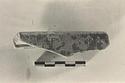
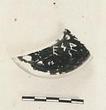
| Rim fragment from a large partly glazed krater, glazed red-brown on inside and rim only.
Writing on inside: Gravelly filling beneath floor of earlier drain, just south of building C. 2229 Leica ... 22 April 1937 |
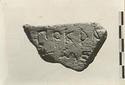
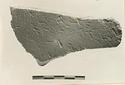
| Small fragment from a slab of brick, like P 23001 (ΜΣ 492).
Inscribed on the smooth face: Horos Terrace Trench, ostrakon pit. 581 Leica ... 10 April 1953 |
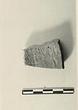
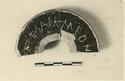
| Two joining fragments from the wall of a large storage jar.
Inscribed on the outside:
Thin streaky black glaze on the outside. Horos Terrace Trench, ostrakon pit. 580, 632 Leica ... 8-10 April 1953 |
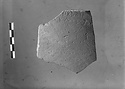
| Fragment from the wall of a large vase, glazed inside, covered on the outside with a thin brown wash on which there is a horizontal band in darker glaze.
Scratched in the dry clay on the outside:
Coarse ... 15 April 1934 |
| From a krater glazed inside only.
Incised (in)side: Pocket in bedrock with early 5th. c. sherds. Leica ... 22 May 1936 |
| Wall fragment from a small krater with thin brown glaze on the inside.
Incised on the inside: Inside the "exhedra" in fork of Great Drain, layer II. 2267 Leica ... 14 March 1938 |
| Kylix base.
Incised underneath: Well F, early 5th. c. Leica ... 19 June 1935 |
| From the shoulder of a coarse pot.
The letters, scratched on the outside, are upside down with respect to the shape of the pot and at an angle with the wheelmarks:
Micaceous buff clay, unglazed. No ... August-September 1932 |
| A flat fragment, suggesting a burned brick, one face neatly smoothed; the other left rough.
Inscribed on the smooth side:
Pinkish-buff fabric. Horos Terrace Trench, ostrakon pit. 581 Leica, LIX-1 ... 10 April 1953 |
| Rather more than half of a kylix base preserved, mended from three pieces. Profile, torus below, groove above; edge and outer part of underside unglazed.
Inscribed on the top:
Below, traces of a graffito: ... 15 May 1936 |
| From a kylix base, incised beneath.
Joins P 8547. Street, 5th. c. fill. Leica ... 20 March 1936 |
| Fragment of kylix foot, large and heavy, with double torus profile. About half the foot preserved. Black glaze above and below, save for the upper edge of the foot, and a line beneath.
Incised on the ... 18-19 May 1936 |
Same filling as Theseion Street Deposit D 7:2 but separate list.
Perhaps also P 7904. Area disturbed by Turkish (50-56/ΜΓ-ΜΣΤ).
This is 3-4 m. west of Hephaisteion, and the hole was probably filled at ... Ca. 500-470 B.C. |
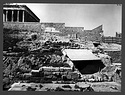
Ostrakon Pit (Horos Terrace Trench). Oval pit cut into bedrock. Packed filling of stones, coarse sherds and roof tiles; among these a few fragments of finer vases and 22 ostraka, probably from the ostracaphoria ... Ca. 490-480 B.C. and later |
Packing under cobblestones 7 or 8 meters west of the Temple of Hephaistos. A similar filling found in a small hole in bedrock three or four meters north of the Temple. The high quality of the pottery from ... Ca. 500-440 B.C. |
A well (diameter 1.10m) at the east edge of the valley road leading from the SW corner of the Agora, about 90m SW of the Tholos. The mouth of the well was subsequently covered by the east wall of the Great ... Ca. 500-480 B.C. |
| A cave-in not long after the digging of this shaft destroyed its possible usefulness as a well and thereafter it was used as a dump. Two principle periods of such use were noted, and within these several ... Ca. 575-480 B.C. |
| Lang, L ... American School of Classical Studies at Athens ... The scraps of pottery on which were written the names of candidates for ostracism are one of the most intriguing pieces of evidence for ancient democracy found in the Athenian Agora. This book is a complete ... 1990 |
|
|