|
|
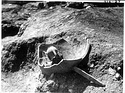
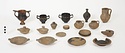
| Grave 4 in notebook: urn burial. Lower part of a storage jar (P 15407) containing the bones of a small child along with a black glazed kantharos (P 15409) and a banded pelike (P 15408) ... 325-300 B.C. |
Indicated as "Grave 6" in notebook but recognized as not a grave: "probably a rubbish pit" [deposit notebook summary]. Concentration of pottery, burning, animal bones, snail shells and seashells, probably ... Late 4th-early 3rd c B.C. |
| North of House G (RSY=Pyre 13).
Concentration of artifacts, small pieces of bone, and burnt material in stratum, no pit discerned. The pyre is cut by the trench of a wall of a Roman house to north. It ... 290-250 B.C. |
| Pyre in House N, room 4 (RSY=Pyre 7), in the industrial area west of the Areopagus.
Pottery, mall pieces of calcined bone, log, wood cinders, and charcoal in diamond-shaped pit in floor sequence. The pyre ... Late 4th-early 3rd c. B.C. |
| Pit, partly cleared; dumped filling of first half of 3rd. c. B.C., but with considerable material of the 4th. c. Hellenistic.
Its rotten schist walls collapsed some time near then and it was filled up ... 4th-3rd c. B.C. |
With cistern at 17/ΟΕ-ΟΣΤ (P 10:2), two chambers connected by a passage.
18/Π went out of use first and was closed off from 17/ΟΕ-ΟΣΤ; filled up at one time with material dating between 350 and 300 B.C ... 325-285 B.C. |
Cistern at 65/ΚΗ (and Channel). Cistern in the northwest room of the annex to the Poros Building west of the Areopagus. Part of the same system as D 17:4 and D 17:5, the chambers connected by long tunnels ... 300-250 B.C. |
Cistern (diameter 0.90m) with two channels; the fill of the cistern proper, below the scant upper (Byzantine) deposit, appears to have been dumped all at the same time, to 325-275 B.C. Notebook says "all ... 325-275 B.C. |
|
|