|
|
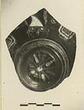
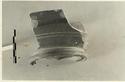
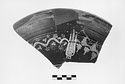
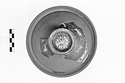
| Fragment preserving ring-knob and part of top. Inside the ring-knob, star in clay-color, with white blobs. A scraped groove around the top outside the knob; then a zone of ornament in clay color and white: ... 28 February, 1-2 March 1933 |
| Only a small segment remains. Restored in plaster. Shallow central well. Low vertical rim rising about floor. Two horizontal grooves on underside of floor.
Firm red glaze. Reserved on floor of central ... 7-17 April 1936 |
| About half preserved. Bowl, or lid, with substantial ring foot and low vertical rim. Inside unglazed, except on rim. On the outside, two wide shallow scraped grooves with West Slope decoration between: ... 8 April 1948 |
| All of rim and part of top missing. Restored in plaster. Heavy low ring-knob. Neat circular depressions on underside at center; the lid can be reversed and used as a fish plate. Decoration of garlands, ... 8 June 1937 |
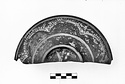
| Fragment from side and rim of deep plate with upturned plain rim. Wall bound at top and bottom by pairs of grooves scratched through glaze; row of dots in white just below; then a large wreath; on one ... 15 February-2 March 1938 |
| Broken all around, about three-fourths of base and one-fourth of floor preserved, rim completely gone. Slightly flaring ring foot, underside glazed with slight central bump. Scraped grooves on resting ... 24 July 1971 |
| About one-third missing and chips. High ring foot, grooved around top outside; shallow body with plain low upturned rim.
Fairly good glaze, black to red. House N, Room 4; Pit through layers 5-6; late ... 14 October 1947 |
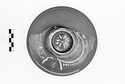
| Profiled ring foot and adjacent part of body preserved. Restored in plaster. Deep plate with west slope decoration on exterior: within foot, eight-pointed yellow star with white dots between points and ... 12-15 May 1939 |
| [Originally identified as plate]
Restored in plaster. Large ring foot with miltos grooves on upper and under faces. Straight upturned rim. Around base, alternating pointed rosettes of white and thinned ... 26 March 1936 |
House N, Room 4, Pit through layers 5-6. Debris filling, mixed context. Estimated Grid ... Late 4th. c. B.C. into early 3rd c. B.C. |
Layer 7 in South Peristyle of court of Roman House Ε. Irregular cutting in bedrock with sand, gravel, fallen bedrock. Some burning ... 275-250 B.C. |
Evidence of stratification into five layers, although joins between the layers. Layer VI added when the construction of the Roman building above required it. No subdivisions assigned.
Flask-shaped cistern ... Early 3rd-late 2nd c. B.C. |
Drawshaft of a complex cistern system with two chambers (D 11:4, E 11:1), two more drawshafts (D 11:3, D 12:2), and two blind tunnels, all of which were filled later than D 11;2. Coins:
26 March 1936 #1 ... 300-215 B.C. |
At 67/ΙΗ, at the northeast slope of the Areopagus.
Cistern with drawshaft, 4.60m deep. The drawshaft had been cleared to bottom in the eighteenth or nineteenth century, and some of the fill in the main ... Most second half of 3rd c. B.C. |
Cistern with considerable dumped fill at the north foot of Kolonos Agoraios. It may have been abandoned ca. 295-295 B.C.; it will have been filled by 280 B.C.
Multiple vessels share same stamps, and painted ... Ca. 325-250 B.C. |
Cistern with two tunnels, the one entering its neck cut off by an early Roman well, the other, at the bottom not excavated.
Chamber conical in shape, with a depressed draw basin in the center of the floor ... Early Roman-3rd c. B.C. |
| Rotroff, S ... American School of Classical Studies at Athens ... The second of two volumes on the Hellenistic fine ware unearthed in excavations in the Athenian Agora, this book presents the Hellenistic wheelmade table ware and votive vessels found between 1931 and ... 1997 |
|
|