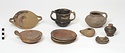
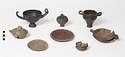
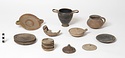
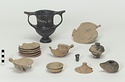
|
|
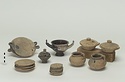
| Burned deposit: Middle Terrace, south of Archaic cemetery.
RSY: Pyre 10.
Pottery, burnt bone, charred logs, and heavy burning, recovered by tunneling under the cement floor of a Late Hellenistic workshop, ... Ca. 325-300 B.C. |
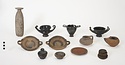
| Pyre in Room 2, area west of street (RSY=Pyre 12).
In courtyard. Artifacts, bone, ash, carbon, and cinders in pit in floor sequence. The rectangular pit was cut into a white strosis with marble chips (ΠΠ ... 315-300 B.C. |
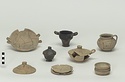
| Pyre in Room 1, area west of street (RSY=Pyre 11).
Early in the third quarter of the 4th. c. B.C.
In courtyard. Artifacts, bone, and cinders in irregular pit in floor sequence. The pit had been dug into ... 350-330 B.C. |
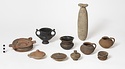
| Pyre 2 in Central House, Room X, under strosis 9. Signs of burning, carbonized food, animal bone.
In room south of courtyard. concentration of artifacts, bone, and charred material in floor makeup, no ... 290-275 B.C. |
| Pyre in layer 8a in SW corner of Room 7 of Greek House δ.
Oval pyre; 0.60 (n-s)x 0.35 (e-w).
The pyre was covered by the surface of layer 8 and extended slightly into layer 9 below it. Small bone fragments, ... 325-300 B.C. |
| (RSY=Pyre 2). Pyre in the industrial area west of the Areopagus, in House B. In northern corner of room. No pit discerned. A deposit of small stones (a marker/) lay 0.30m above the level of the pyre, ... Third quarter of the 4th. century. |
| Pyre in Room 8 of Roman House H. Concentration of artifacts, bone, and flecks of carbon in stratum, no pit discerned. the pyre lay within a red fill apparently contemporary with it, but with some later ... 300-290 B.C. |
| Pyre in House N, room 2, layer 5 (RSY=Pyre 8).
Near northern corner of room 6. Artifacts, bone, burnt logs, and cinders in square pit dug from level of layer 5, through layers 5 and 6; thin clay floor ... 325-300 B.C. |
|
|