|
|
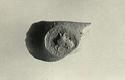
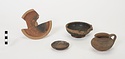
| Curve piece.
Circular stamp with small boukranion in centre. Study: Die 1* Cistern, lower fill; with containers 13-16. Δαμοκρά[τευς τοῦ Ἀριστοκ]λ̣ε̣ῦ̣ς̣
boukranion
(in O framed) Leica ... 8 June 1939 |
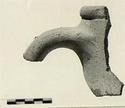
| Part of rim, neck and handle with upper attachment preserved.
Clay rust-colored within with numerous black inclusions, dark buff to purple outside; very coarse.
Long rectangular stamp with a bunch of ... 360-320 B.C. |
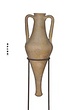
| Intact; long cylindrical toe, widening at end with depression underneath; pointed body, rounded shoulder, concave neck, thickened outturned rim, two handles oval in section.
Capacity: (water v. 77) 7.1235 ... 21 July 1975 |
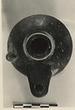
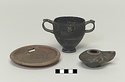
| Intact.
Watch-shaped lamp on high base. Pierced lug at one side. Broad scraped groove around filling hole.
Dull black glaze.
Type IX (clamshell, wheel made) of Corinth collection, type 29A of Agora collection ... 9 June 1938 |
| Intact. Small cooking pot; round bottom; flaring rim; band handle.
Micaceous light brown clay, grayish in parts of outside. Finished Stoa Shop VI, shallow pit in floor below layer I = pyre. 4413 Leica, ... 28 May 1955 |
Flask-shaped cistern (1959) (Cistern under Room 4 in NE corner of Section). Upper filling soft silt with a little pottery. Lower filling hard silt, almost no pottery.
1.35m in diameter at the floor with ... End of the 4th c. B.C. |
| Shallow pit below layer I in Stoa Shop VI (Pyre)
Diameter 0.90; D. 0.15m Under shop VI of the Stoa of Attalos Pottery, ash, burning and packing of small stones in pit in stratum. The pyre was covered by ... Ca. 350 or 325 B.C. ? |
| Small pit (in Layer I) = Grave ("Pyre") Identified as pyre by SIR.
Pottery and burning ("pit filled with black") in pit slightly west of Panathenaic Road, dug into layer I (lot AA 180, much earlier 6th ... 275-250 B.C. |
|
|