|
|
| Burned deposit: Middle Terrace, south of Archaic cemetery.
RSY: Pyre 10.
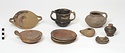
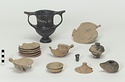
Pottery, burnt bone, charred logs, and heavy burning, recovered by tunneling under the cement floor of a Late Hellenistic workshop, ... Ca. 325-300 B.C. |
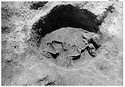
| Dog's Grave, the bones carefully disposed. It contained a small amount of contemporary pottery in the fill, of which some deposited nearby, may have been intended as offerings ... Third quarter of 4th c. B.C. |
| Pyre 2 in Central House, Room X, under strosis 9. Signs of burning, carbonized food, animal bone.
In room south of courtyard. concentration of artifacts, bone, and charred material in floor makeup, no ... 290-275 B.C. |
Pit (= collapsed cistern). Fill mixed, late Hellenistic to early Roman. The cistern floor has an E-W channel, no doubt running from the pit at 107/Ζ to the well at 107/ΙΓ (B 21:24). Coins:
10 June 1939 ... 150-100 B.C. |
| Pyre in House C, Room 8 (RSY=Pyre 6).
Near east corner of room 8. Artifacts, burnt bone, burnt sticks, and large cinders in a shallow pit dug into surface of layer 3, and covered by layer 2. Some cinders ... 350-325 B.C.-end of 4th c. B.C. |
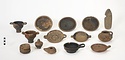
Shallow pit containing pottery, burning and tiny fragments of bone. A dumped group of pottery in an amphora pit, ca. 1.00 m. in diameter, 0.60m. in depth. Many tiny fragments of bone were in the fill ... 375-325 B.C. |
Well at 19/Λ.
The bottom of this well contained a considerable quantity of dug bedrock which had fallen in before the well came into use; over this was a fill with oinochoae representing the POU. The presence ... 340-325 B.C. |
A filling lying over a cobbled floor in a house-complex on the lower north slopes of the Areopagus.
Area in front of E-W retaining wall, just above cobble pavement, disturbed by coins and pottery as late ... 375-275 B.C. |
|
|