|
|
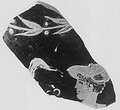
| Small fragment from shoulder and neck of an oinochoe. Around neck, a wreath in thinned clay paint. Below, a head, to left, wearing a large flat hat and facing a torch. The torch and outline of hat in thinned ... About 400 B.C. |
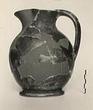
The base is preserved complete, and portions of the walls, handle, and lip. Restored in plaster. Echinus foot, its inner face convex. The underside of the floor is completely reserved and reddened; its ... May-June 1951 |
| Small piece from side of an oinochoe. Part of head and breasts of draped woman, right, with right arm outstretched. Provenience unknown; found in tin with Σ ticket (probaby worthy sherds from unworthy ... (1948) |
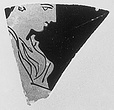
Probably from an oinochoe; broken on all sides.
At the lower part of the fragment a head, right, the mouth and chin broken away. Hasty work. Broad reserved hair line; eye and eyebrow rendered by single ... 20 May 1933 |
| Broken all around. Head and shoulder of a youth looking right. Front part of face is missing. He is wearing an animal's head as a cap, perhaps a leopard. Cut along east wall of East Building ca. 13.50m ... 23 June 1967 |
| Fragment from junction of shoulder and neck of vase; oinochoe? Egg pattern at upper edge of panel. Below, the head and shoulders of a bearded semi-draped man, right; a plain fillet around his head.
In ... 26 April 1947 |
| Broken all around. Face and hands of a figure left, holding a phiale. Lower left, an undertermined object. The phiale done in clay-colored lines in low relief. No relief contour. Interior: thin metallic ... 8 March 1934 |
| Broken all around. Fragment of a closed pot: oinochoe?
Head and shoulders of a youth, left; his right shoulder bare, drapery across other shoulder and chest. Square Building, construction fill. Pier 19 ... 28 July 1949 |
| From the wall of a closed pot. Nude leg of figure walking left; uncertain object at left, above. Lower border: maeander and cross squares.
Bit of contour at back of knee, only. Inner drawing in brown ... 18 February 1937 |
| The mouth and many fragments of the wall are missing. Partly restored in plaster. Satyr running right and looking back, animal skin thrown over his arm; on either side, maenads: on left maenad standing ... July 1965 |
| Pit at 74/ΜΑ (1.10x0.58).
Debris filling containing a quantity of animal bones; probably a household refuse pit Animal bones (domestic animals); cow, pig, goat, sheep, hen, dog, and several varieties ... Ca. 525-470 B.C.
480-440 B.C. |
Crosscut between Middle stoa Piers 1 and 2 from west (south aisle), layer II.
Chiefly late 5th to mid-4th c. B.C. Coins:
2 July 1965 #1 ... Late 5th to mid-4th c. B.C. |
| From the wall of a round-bodied oinochoe; glazed to neck inside, thinned, and brown below. Three joining fragments preserve the figure of Nike, standing to left, and bending to sprinkle incense on a small ... 9, 11 May 1939 |
Dumped debris filling east of East Building, badly shattered. There is a small amount of disturbance from the filling immediately above, but the bulk of the pottery is consistent, and very close to that ... Ca. 470-460 B.C. |
Primarily late Roman material but some scrappy early Roman. Coins:
5 March 1934 #1-#4
6 March 1934 #1-#3
7 March 1934 #1-#2
8 March 1934 #1-#4
9 March 1934 #1-#4
10 March 1934 #1 ... Ca. A.D. 350 dumped fill |
A well about 2.00m. SE of the Tholos precinct wall. The presence of the water-clock strengthens the probability, suggested by its location, that the well served one of the public buildings in the neared ... Ca. 410-390 B.C. |
| This filling is the largest deposit of its time found in the Agora. It may be compared with H 6:5 and with N 7:3.
Dug in soft bedrock to a depth of 11.40m; footholds cut on opposite sides of the shaft ... Ca. 490-450 B.C. |
Well at 45/Θ (Skytha Well) near the north side of the market square. No period of use was distinguished, since it was impossible to clear the well to the bottom. The considerable quantity of dumped filling ... Ca. 460-440 B.C. |
| Moore, M. B ... American School of Classical Studies at Athens ... This volume presents the inventoried red-figure and white-ground pottery found in the Agora Excavations between 1931 and 1967. Although many of these vases have already been published in various reports ... 1997 |
|
|