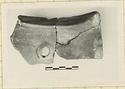
[Agora Object] P 14269: Brazier Fragment

Part of the upper wall and rim from beside the opening. Inward-projecting rim; a vent-hole below it. Household ware; burned inside. From tins. Well 1. Leica, 81-600 PD 1098-c ... 22-28 February 1935

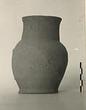
[Agora Object] P 26591: Jug

Complete except for lip fragment and handle. Cylinder neck, disk foot, plain, slightly flaring rim. Band handle seems to have been cut off before firing. Not a recognizable Attic shape and probably unfinished ... 10 June 1959

[Agora Object] P 26592: Olpe: East Greek

Handle missing. Spherical, with short flaring neck, plain rim; disk foot; attachment for band handle. Band inside rim. Glazed outside except for reserved band near middle. Weak red glaze, worn. Pinkish-buff ... 10 June 1959

[Agora Object] P 26174: Tripod Fragment

Leg of miniature tripod, burned at the tip. Incised ornament inside and on sides. Coarse micaceous fabric. Old Grid: ca. 35/ΚΒ-ΚΓ. Deep pit; upper and lower filling; 6th. c. B.C. context. Leica, 81-600 ... 7-8 April 1958

icon

[Agora Object] P 26568: Skyphos

Cracked; small joining lip fragments; small part of lip missing. Reserved handle zone. Otherwise covered with brown glaze with one red spot outside, glaze inside. Brick red glaze; pinkish-buff clay ... 10 June 1959

[Agora Object] P 26583: Bowl

Numerous joining fragments preserve most of rim and much of wall. Simple rounded bowl with plain rim. Unglazed and burnt gray. Light gray clay. Probably an experiment. Misfired. Panathenaic Way, cut ... 10 June 1959

[Agora Deposit] L 17:2: Pit

A deep pit in bedrock over mouth of well. Context archaic, 6th c. B.C., but with some traces of later disturbance. Found a circle for a well at the bottom, much water, no sherds. Lay 2.20m south of Well ... 6th c. B.C.

icon

[Agora Object] P 26579: Potter's Test Piece

Wall of Subgeometric skyphos. Hole cut at about middle after glazing and perhaps after firing. Dull brownish-gray to black glaze. Highly micaceous clay. Panathenaic Way, cut IV, cutting F1, from pots ... 10 June 1959

icon

[Agora Object] P 21805: Plate Fragment: Cooking Ware

Truncated wedge of plate's bottom and side preserved. Flat floor, heavy thickened rim, concave on outer face; small lug at top of rim. Coarse micaceous clay, reddish-brown. Bottom of plate inside and one ... 14-19 June 1951

icon

[Agora Object] P 26569: Cup

Three joining fragments preserve complete cup except for part of rim. Set off rim, slightly flaring. Disk foot; band handle. Dark red glaze inside and out, worn in spots. Reddish clay. Panathenaic Way, ... 10 June 1959

icon

[Agora Object] P 26571: Potter's Test Piece

Base of skyphos. Disk foot. Hole cut in bottom before firing. Underside carelessly glazed; also inside of pot and over breaks. Dull black glaze thinned to brown in spots, with a metallic sheen in others ... 10 June 1959

[Agora Deposit] P 14:2: Well at 53/IH

Well at 53/ΙΗ, east of the east Stoa Plateia. Diameter 1.40-1.50m. Shaft worked with chisel, tapers toward bottom. Plentiful water. Uniform fill with field-stones, perhaps including period of use ... 775-725 B.C.

icon

[Agora Deposit] S 17:2: Circular Pit and Irregular Cutting

Circular pit and irregular cutting north of it. Diam. of pit ca. 0.80m; Dimension of irregular cutting ca. 1.00x1.20m. The pit was dug into bedrock and filled with red earth which was packed with undisturbed ... Second half of 7th c. B.C.

[Agora Deposit] F 12:5: Well 1

Unfinished well cut in bedrock to the southwest of the Tholos; dumped filling containing much material of the 7th c. B.C. but extending into the 6th ... 7th-ca. 570 B.C.

[Agora Deposit] L 11:1: Well in a West Part of Odeion Cavea

Well a in west part of Odeion Cavea, probably unfinished. The dumped fill mostly potters' refuse including test pieces. Well D. Diameter ca. 0.90m ... Early Protogeometric

icon

[Agora Publication] Agora VIII: Late Geometric and Protoattic Pottery: Mid 8th to Late 7th Century B.C.

Brann, E. T. H ... American School of Classical Studies at Athens ... This volume reports on Athenian pottery found in the Athenian Agora up to 1960 that can dated from about the middle of the 8th century, when “the appearance of a painter of sufficient personal distinction ... 1962